BREAKING

Sunday, July 2, 2023

Japan Confers Decoration on Dr. Cynthia Neri Zayas


Wazzup Pilipinas!?


Former director of the UP Diliman Center for International Studies (CIS), Dr. Cynthia Neri Zayas was conferred by the Japanese government the prestigious Order of the Rising Sun, Gold Rays with Rosette during the 2023 Spring Conferment of Decorations on Foreign Nationals, in recognition of her contributions for promoting academic exchange and cultural understanding between Japan and the Philippines.

According to the Embassy of Japan on its Philippine website, the Japanese government acknowledges Dr. Zayas as the Philippines’ leading maritime anthropologist and foremost Japanologist. Her field of excellence includes cultural anthropology, maritime anthropological studies of Asia, and cultures of disaster. She is also credited for pioneering maritime anthropological studies in the Philippines, together with Japanese anthropologists, after completing her master’s and doctoral degrees in Japan. Her internationally recognized works on the cultures of disasters and free women divers, or ‘ama,’ in Japan have deepened the understanding of Japanese culture and society worldwide. Dr. Zayas is also acknowledged as instrumental in introducing Japanese traditional performing arts to the Philippines.


The Order of the Rising Sun is the third highest order bestowed by the Japanese government to exemplary individuals, following the Order of Paulownia Flowers, mostly reserved for politicians, while the Order of Chrysanthemum is bestowed upon heads of state or royalty. It was established on April 10, 1875 during the reign of Emperor Meiji by decree of the Council of State. It was the first ever national decoration awarded by the Japanese government to those who have made distinguished achievements in international relations, promotion of Japanese culture, advancements in their field, development in welfare, or preservation of the environment.

The order consists of eight classes, and the decoration is in the form of a badge, featuring rays of the sunlight from the rising sun, symbolizing the powerful energy emanating from it. An honoree is presented a badge, depending on the class level attained. The awarding of honors, including decorations and medals, is an act performed by the Emperor with the advice and approval of the Cabinet, pursuant to Article 7 of the Constitution of Japan.

Dr. Zayas was one of four Filipino recipients of the prestigious award last April. The other three Filipino awardees were Hon. Alberto Romulo, conferred with the Grand Cordon of the Order of the Rising Sun, for his contributions in strengthening bilateral relations and promoting friendship between Japan and the Philippines; Hon. Delfin N. Lorenzana, conferred with the Order of the Rising Sun, Gold and Silver Star, for his contributions in strengthening national defense relations between the two countries; and, Hon. Gamaliel A. Cordoba, conferred with the Order of the Rising Sun, Gold Rays with Neck Ribbon, for his contributions in strengthening cooperation in the field of information and communication technology. They will receive this award on Monday, at the residence of the Japanese ambassador to the Philippines.
Saturday, July 1, 2023

WITHIN A YEAR, ROBREDO’S ANGAT BUHAY SERVED 20.1k FAMILIES, 15.6K INDIVIDUALS “We are just getting started,” says the Foundation


Wazzup Pilipinas!?


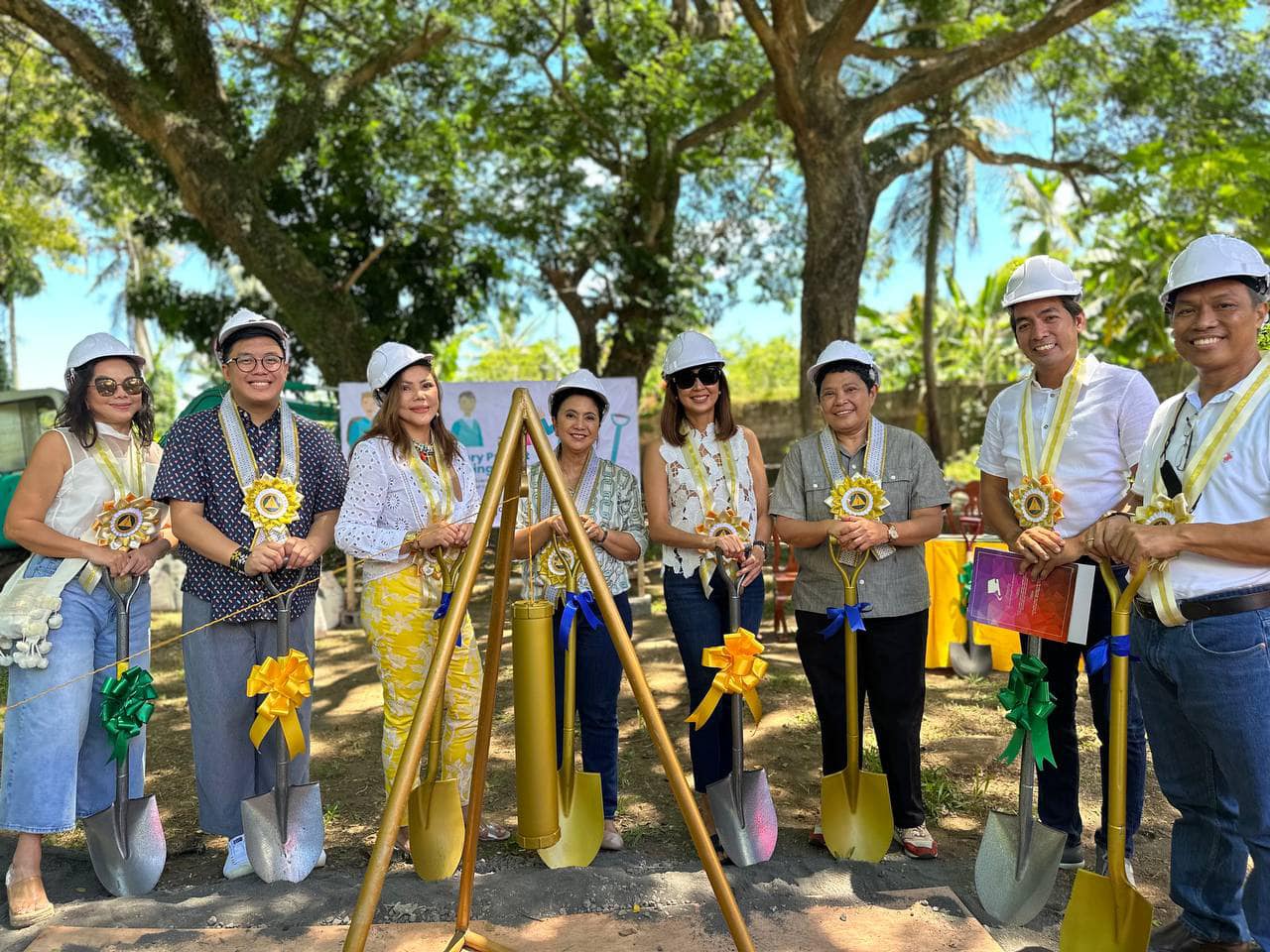
Angat Buhay Chairperson Atty. Leni Robredo leads the groundbreaking ceremony for a dormitory project at Central Bicol State University of Agriculture - Calabanga Campus last June.]

Angat Buhay Foundation, the non-governmental organization (NGO) founded and chaired by former Vice President Leni Robredo, has helped a total of 20,131 families and 15,636 individuals across 176 communities since it was established last July 1, 2022, according to a report released on Saturday during the foundation’s first-anniversary celebration.

“Nagsisimula pa lang tayo (We are just getting started),” said Raffy Magno, executive director of Angat Buhay.

From July last year to June 2023, Bayanihan e-Konsulta, the foundation’s flagship telemedicine program, assisted 7,706 unique patients with the help of 285 medical volunteers and at least a thousand non-medical volunteers. The program, originally for COVID-19 response, has expanded to mental health and other non-emergency medical issues as well.

At least 1,214 underweight and severely underweight children aged 6 to 59 months are also enrolled in the foundation’s nutrition program. The said program is present in seven (7) sites including Himamaylan in Negros Occidental and Maslog in Eastern Samar.

Angat Buhay also established 137 learning hubs nationwide to help non-readers and numeracy-challenged learners. Community learning hubs or CLH house equipment and learning tools for students, including trained teaching volunteers.

Learners go through a program that targets their skills in reading and math in specialized ‘Angat Basa’ and ‘Angat Bilang’ centers. In a year, at least 5,000 students have been enrolled in the program.

“Improving literacy and numeracy of Filipino students needs community-based involvement,” said Magno. “We enjoined the assistance of education experts and stakeholders in designing the modules, training, and evaluation system. In our monitoring, all hubs improve learners’ literacy while 95% of students improved in their numeracy from pre-test to post-test,” he also said.

Within a year, Angat Buhay also finished construction and turnover of dormitories in Infanta, Quezon and Camarines Norte and classrooms in Camarines Sur and Maasin, Iloilo.

More than 20,000 families affected by natural and man-made disasters from 93 displaced and affected communities were also given immediate relief and assistance and rehabilitation initiatives by the NGO since it was established.

Early this year, Angat Buhay also inked a deal to establish a disaster preparedness and response center to train volunteers for disaster response and serve as a headquarters for the foundation’s relief efforts.

In August last year, Robredo launched the Angat Bayanihan, a volunteer network that aims to empower people’s organizations and help them give back to their respective communities. Since then, Angat Bayanihan has mobilized 188 grassroots organizations and 13,705 individual volunteers, according to the foundation. The said network has conducted community kitchens, medical missions, and relief distribution, among others.

“Angat Buhay is now a movement, and we are sending a message to millions of Filipinos that they are not alone in demanding meaningful participation,” said Magno. “Ang Angat Buhay ay pagpapatupad ng adhikain ng bawat Pilipinong may tiwala sa kanyang sarili at sa kapangyarihan ng bayanihan (Angat Buhay embodies the aspiration of the Filipino who has faith in oneself and in the power of volunteerism),” Magno concluded. #
.

Friday, June 30, 2023

Pinoy archaeologist helps rewrite human history in Southeast Asia


Wazzup Pilipinas!?


New findings from a cave in northern Laos add to a growing body of evidence that modern humans arrived in Southeast Asia over 80,000 years ago, tens of thousands of years earlier than previously thought. The groundbreaking findings were recently published in the prestigious journal, Nature.


Filipino geoarchaeologist Vito Hernandez (second from right, with camera) with his fellow researchers in Tam Pà Ling in northern Laos. (PHOTO CREDIT: Macquarie University / Kira Westaway)

Analyses of fossils and sediments from Tam Pà Ling (“Cave of Monkeys” in Lao) by an international team of scientists—including a Filipino researcher formerly from the University of the Philippines (UP) and currently at the Flinders University Microarchaeology Laboratory in South Australia—has pushed back the time when we know our species, Homo sapiens, was present in Mainland Southeast Asia.

The newly-discovered fossils provide unmistakable evidence of the presence of modern humans in northern Laos as far back as 86,000 years ago. This is almost 20,000 years older than most of the evidence from sites so far studied in Southeast Asia and adds further confirmation of a pre-60,000-year-old dispersal of modern humans into East Asia.

“This discovery is helping us better understand the distribution of our direct ancestors at a time when we know other populations of humans, now extinct, existed,” said Vito Hernandez, the Filipino geoarchaeologist who is part of the team that published these recent findings from Tam Pà Ling.

This research in northern Laos, including a previous discovery of now-extinct humans known as Denisovans present between 164,000 and 131,000 years ago in Tam Ngu Hao 2 (“Cobra Cave”) located in the same mountain as Tam Pà Ling strongly suggests that this part of Southeast Asia is an early human dispersal route. “This proves that our human ancestors also traveled along forests and river valleys apart from following islands and coastlines as they moved eastward to Australia, where they are controversially thought to have migrated as early as 65,000 years ago,” Hernandez explained.

“Analyses of the fossils in Tam Pà Ling suggest that these early modern humans were part of an immigrant population, but whether their genetic line successfully survives in current populations is yet to be determined,” he added.

Initially, fossils from Tam Pà Ling were hard to date, resulting in skepticism about previously-presented evidence from the cave. This led the geochronology and geoarchaeology specialists of the team to strategically apply their techniques to ascertain how the dated sediments relate to the fossils, and determine a precise age for both.

“The dating and the quality of fossil preservation is important as we’ve seen from research led by scientists like Professor Armand Mijares at the UP School of Archaeology, but as we’ve also seen from our research and other human evolutionary research like in Denisova cave in Russia, a very close collaboration between the Earth and Human sciences is necessary if we are to achieve a more complete picture of how humans evolved and settled into different parts of the world,” he elaborated.

Hernandez was formerly part of the UP Archaeological Studies Program, now the UP School of Archaeology, where he obtained his Master of Science and taught undergraduate classes in Archaeology. He was also part of the Science and Society Program of the UP Diliman College of Science (UPD-CS), where he managed classes in Science, Technology and Society. “I hope to return after my research work in Australia and contribute to making our science serve Philippine society,” he concluded.


Sources:

Freidline, S. E., Westaway, K. E., Joannes-Boyau, R., Duringer, P., Ponche, J.-L., Morley, M. W., Hernandez, V. C., McAllister-Hayward, M. S., McColl, H., Zanolli, C., Gunz, P., Bergmann, I., Sichanthongtip, P., Sihanam, D., Boualaphane, S., Luangkhoth, T., Souksavatdy, V., Dosseto, A., Boesch, Q., … Demeter, F. (2023). Early presence of Homo sapiens in Southeast Asia by 86–68 kyr at Tam Pà Ling, Northern Laos. Nature Communications, 14(1). https://doi.org/10.1038/s41467-023-38715-y

Ang Pambansang Blog ng Pilipinas Wazzup Pilipinas and the Umalohokans. Ang Pambansang Blog ng Pilipinas celebrating 10th year of online presence
 
Copyright © 2013 Wazzup Pilipinas News and Events
Design by FBTemplates | BTT
